Artworks

ARTISTS
PRESS RELEASE:
Sara Arsenyuk The Planets Go Wild
Curator: Dr. Doron J. Lurie
Opening Event: Thursday, September 3, at 7:00 PM
Gallery Talk: Friday, September 18, at 11:00 AM
The word “planet” derives from ancient Greek and means “wanderer.” It refers to planets – or celestial bodies that move in a fixed orbit around the sun. Sara Arsenyuk is deeply interested in planets: she studies them and incorporates them into many of her paintings.
Arsenyuk is by no means the first artist to have been fascinated by them. Israeli artists Micha Lori and Gabriel Cohen (associated with naïve and outsider art) explored them before her, alongside European artists such as Max Ernst and Hilma af Klint. In the United States, Andy Warhol and illustrator Norman Rockwell depicted the first astronauts on the Moon. It should immediately be noted, however, that not every painter who paints circles necessarily intends them to represent planets: Wassily Kandinsky painted many circles, and there is no known attempt to associate them specifically with planets.
Popular culture and literature have likewise offered no shortage of cosmic sources of inspiration: from pioneering science-fiction writers Jules Verne – who imagined a journey to the Moon launched by means of an enormous cannon, and British author H. G. Wells, who wrote The First Men in the Moon, to Israeli popular music. Songs such as Ballad Among the Stars, portrayed a love affair between Venus and Jupiter, alongside popular songs performed by Israeli military ensembles such as Ya Yare’ach (“Oh, Moon”) and Kochav HaTzafon (“The North Star”). In Europe, the Italian hit Guarda che luna (“Look What a Moon”) became enormously popular.
Sara Arsenyuk, 29, a graduate of the Department of Multidisciplinary Art at Shenkar College, has developed a highly personal and original artistic approach to the depiction of planets and celestial bodies in general, and to their influence on what happens to us here on Earth. Is this merely an intellectual fascination, or does Sara perhaps receive messages from other worlds? And what, after all, is the “Muse” if not a “message from another world” – sent by those Muses who dwell somewhere upon Mount Olympus, Helicon, or Parnassus in ancient Greece?
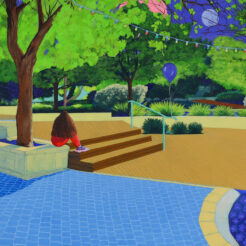
Unlike the many artists who work with NASA, the American space agency, producing scientifically accurate depictions of the solar system, Sara inhabits a fantasy world of her own. In her paintings, the planets appear only in the upper part of the picture, in the background, in the area traditionally reserved for the sky. Does this mean that the lower portion of her paintings is realistic, while only the upper portion belongs to fantasy? Of course not. Sara’s planets may appear as glowing spheres of energy, but this does not preclude extraordinary events from taking place in the lower, supposedly “realistic” part of the painting as well.
For example, within the interior of a room we sometimes see small rectangles containing landscapes. Are these pictures hanging on the wall, or are they windows through which we glimpse the landscape outside? Is there a divide between the “lower,” earthly world in her paintings and the “upper,” cosmic one? Not necessarily. Rather, Sara seems to have taken upon herself the task of mediating between these two worlds.
Sara lives and works alongside her twin sister, Elisheva. Last year, the two presented a joint exhibition at Zemack Contemporary Art titled Upon a Second Glance. Although they share a studio, live in the same house, and draw on similar stylistic sources of inspiration, each has developed an independent artistic language of her own. The Arsenyuk sisters are something of a natural phenomenon: the love and partnership between these twin sisters/twin angels is almost impossible to describe.
Both were born on the Crimean Peninsula, which was then part of Ukraine. Their family immigrated to Israel in 2002, when the girls were five years old.
Sara recalls: “I came to the art world out of a very strong inner feeling. My mother is a painter. Everything I knew as a child in Crimea about painting and color came from my mother’s paintings. I have to say that we grew up in a home of classical art—not contemporary art. My mother, Galina, who had studied at a traditional painting college in Ukraine, simply told us: ‘If you want to paint, take a pencil and paper and start drawing.’ And that is exactly what we did. For as long as I can remember, I have always had an intensely colorful inner world.”
In an interview with Hagit Peleg Rotem (Portfolio, 2025), as well as in my own conversations with the sisters a year and a half later, the twins described their transition to studying at Shenkar:
“When we arrived at Shenkar College, we were somewhat shocked, which is understandable because we came there with the mindset of classical painting. The way we expected to be taught painting was completely different from what we encountered. You could say that our eyes were opened to entirely different worlds, and in that respect it was amazing.”
Must Sara Arsenyuk’s style be situated and categorized? If so, we quickly discover that doing so is both difficult and rather complicated. Her work contains an intriguing mixture of “Fantastic Realism,” rooted in the Vienna School, a touch of Surrealism—particularly the optical deceptions associated with René Magritte – and a free, colorful imagination without boundaries. Some see in this colorfulness a “psychedelic influence,” although that interpretation is certainly open to debate.
At times there are also passages of “Pattern Painting”: identical or similar forms repeated obsessively, an abundance of detail producing a kind of visual rhythm across the painted surface. In other words, Sara’s work contains a wealth of influences and styles, fused together into an artistic language that is uniquely her own: an individual journey of the psyche through an ocean in which the conscious and subconscious intermingle.
Her paintings sometimes appear to have emerged from a hallucination, and curator Shaul Shalev aptly described Sara Arsenyuk’s paintings as a “daydream” in the 2025 exhibition Upon a Second Glance. Most of Sara’s paintings are densely packed with detail, leaving almost no empty or quiet space. Might this, as some psychologists would perhaps argue, express a horror vacui – a “fear of empty space”?
Can Sara be seen as “a friend from another planet”? Does she sometimes experience a mystical revelation, in the Kabbalistic sense of the term? Does she see a light that most of us are unable to see?
Sara explains: “I spoke about the dreams in which I saw many planets – enormous and frightening – as though the end of the world were about to arrive at any moment, as a result of a collision or a tremendous explosion between them. They brought with them a great deal of anxiety and fear.
“I also made a three-dimensional work about the planets. In that work, the planets were made of wire and colored beads, and they were different sizes. They were connected to one another at different distances and different heights. There, I spoke about the planets as human souls—about how I see them and about the relationships between them.
“I then began to think that when I paint the planets, which are different worlds in space, perhaps they represent another kind of presence. The planets are out there in space, in the sky. They are enormous and very close, and in a sense they can see everything that happens here.
“Just as they can evoke a feeling of fear and anxiety – or, conversely, of calm and serenity—they glow, they are far away, and they are simply present. And people are like that too.”


